
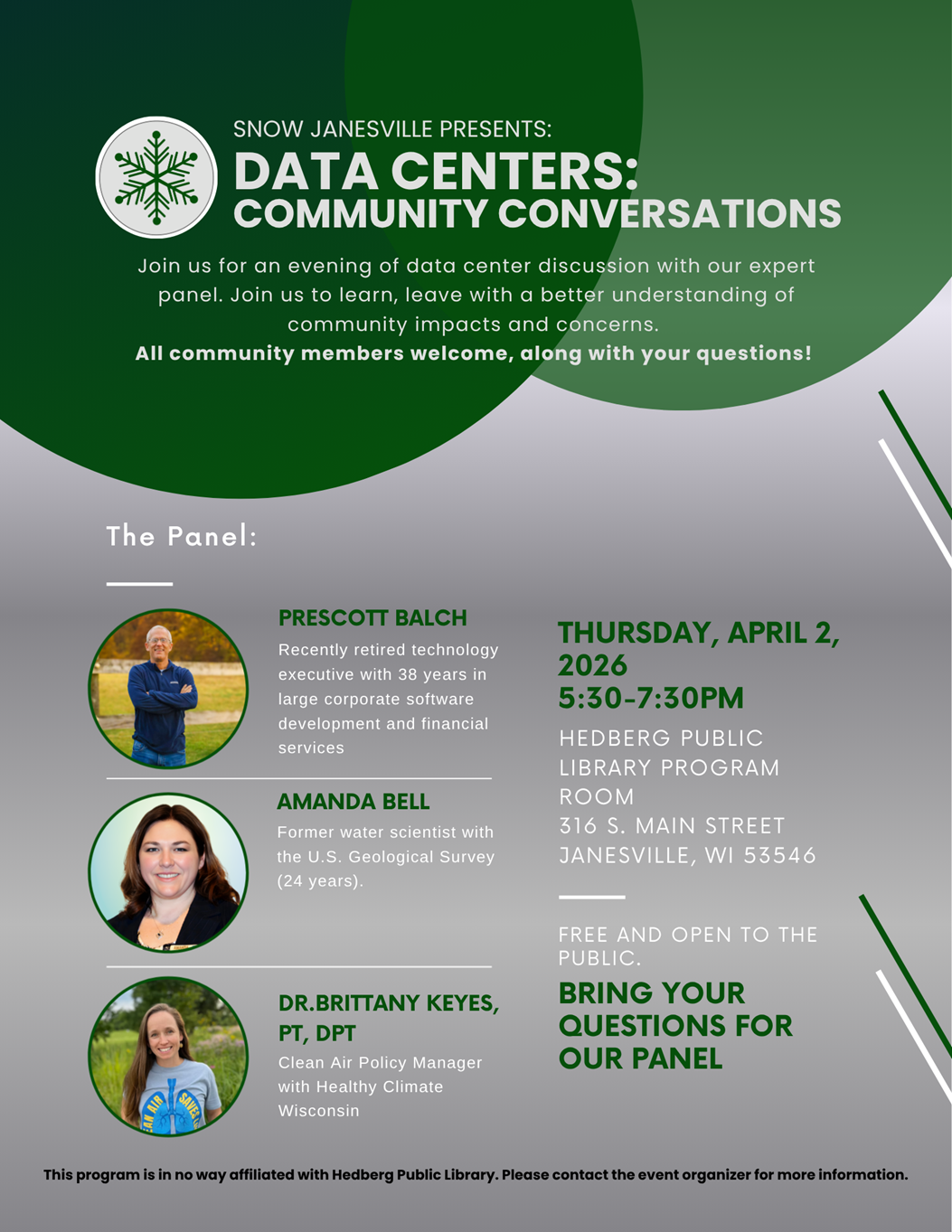
JANESVILLE — SNOW Janesville is hosting a community education event, Data Centers: Community Conversations on Thursday, April 2, 2026 at Hedberg Public Library (5:30 pm, Program Room).
According to a news release, Janesville’s citizens are encouraged to join SNOW Janesville to listen, learn and discuss data center impacts and concerns during our community education event.
SNOW Janesville, or Southside NOW! is a grassroots group connecting citizens, local businesses, and community partners to advocate for south side Janesville development and improve quality of life for local residents and businesses.
The program will include a panel presentation with a community Q&A session to follow.
Panelists for the evening will focus on 3 specific areas:
1. Data center risks and myths (taxes and TIDs) – Prescott Balch
2. Water – Amanda Bell
3. Community Health Impacts – Dr. Brittany Keyes
Prescott Balch is a recently retired technology executive with 38 years of experience in large corporate software development and financial services. He currently resides in Caledonia and was involved with the economic evaluation of Caledonia’s proposed data center, as well as other data center projects around the state.
Amanda Bell spent 24 years as a water scientist with the U.S. Geological Survey, where she led national research programs and managed a three-state science center covering the Upper Midwest. She served as the National Ecological Sampling Coordinator for the NAWQA program, overseeing water quality monitoring at stream sites across the country. She now lives in Pardeeville and stays deeply connected to Wisconsin’s water and land through her work, her community, and her family.
Dr. Brittany Keyes is a physical therapist and the Clean Air Policy Manager with Healthy Climate Wisconsin, a statewide nonprofit of health providers working to address environmental pollution to improve patient and community health. Brittany is a former City Council Vice President from the City of Beloit. She has been advocating to improve community health across the state for the past two years, working specifically on new, large gas plant proposals, delayed coal plant closures, and now hyperscale data centers, as these are rapidly becoming a heightened environmental health threat across Wisconsin and the country.